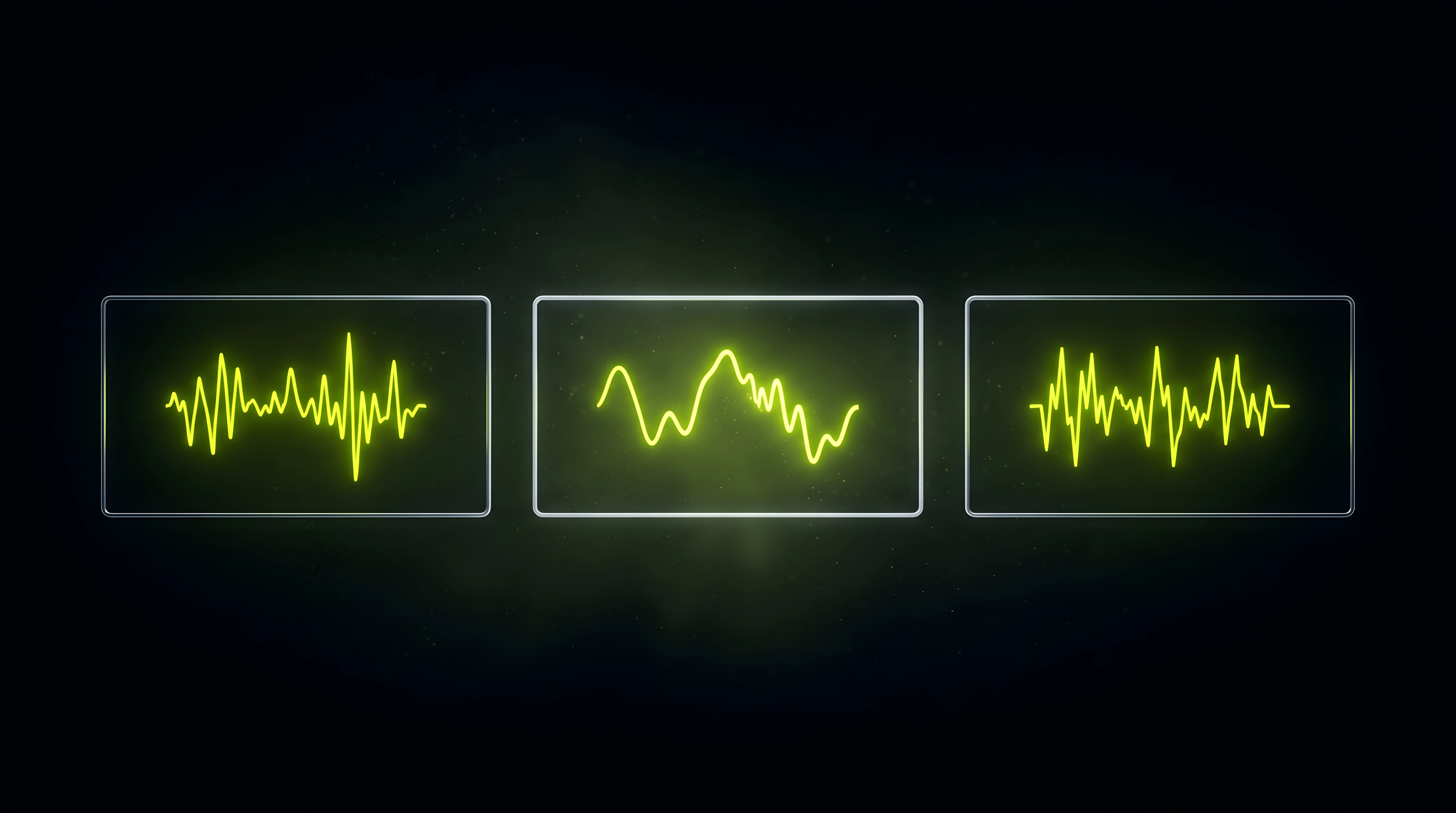
The scope was signed. The work got made. Three strong sound logo options sit in a folder, exported, labeled, ready. The producer sends the email, hits send, and then waits nine days for a reply that says: "Thanks! We're discussing internally."
That silence is almost never about the sound. It's about the fact that the client was handed three audio files and no way to think about them. Design clients get comps pinned to a board with context and a recommendation. Audio clients get a zip.
Presentation is the part of sonic branding work that producers are least trained for and that decides the most. A well-scoped engagement can still stall out here, and a producer who nails the presentation gets a decision in one session instead of three rounds of committee drift.
Why Sound Presentations Fail Where Design Presentations Succeed
A logo comp can be looked at for as long as someone wants. Eyes move around it, compare it to the last one, come back. A sound logo is two seconds long and then it's gone. By the time the third option plays, the first one is a vague memory of a feeling.
This isn't a client attention problem. It's a structural property of the medium. Audio is temporal: it can't be scanned, only replayed. The person evaluating it is doing memory work rather than comparison work, unless the producer builds the comparison for them.
The second failure is vocabulary. A marketing manager can say "the logo feels too corporate" and everyone knows roughly what to fix. Ask the same person what's wrong with a sound and you get "I don't know, it's just not quite it." That's not unhelpfulness. Nobody taught them the words. The producer's job in a presentation is to hand over the words before asking for the verdict.
Present Three Options, Never Two or Five
Two options force a binary and invite the client to invent a third. Five options make the room hunt for a favorite instead of making a decision, and guarantee that the winner will be a Frankenstein of parts from three of them.
Three works because it lets the producer frame a range rather than a menu. The set should represent three different stances, not three variations on one idea:
One that leans warm and human
One that leans precise and mechanical
One that sits between them, closest to the brief as written
That structure does something subtle: whichever option the client picks, they've told the producer something about the brand's real appetite, not just their taste in melodies. If a client picks the mechanical one when the brief said "friendly," that's a briefing correction worth more than the sound itself.
Building three genuinely distinct options is faster than it sounds when the sonic decisions are made deliberately — the anatomy of a sound logo breaks down which parameters actually create distinction (pitch, timbre, motion, duration) versus which just create noise.
Frame Each Option Before It Plays
The single highest-leverage change most producers can make: say what an option is meant to do before playing it, not after.
Unframed, the client hears two seconds of sound and reaches for an instinct. Framed, they hear the same two seconds and evaluate it against a stated intention. The difference in feedback quality is enormous.
A frame is one sentence, in brand language:
"This one is built to feel like an opening — it rises, it doesn't land hard. It's the version that fits if you want the brand to feel like it's inviting people in."
Then play it. Then stay quiet.
The silence after is deliberate. Producers fill it out of nerves — explaining the synth, apologizing for the mix, pointing out what they'd change. Every word spent there teaches the client to evaluate the production instead of the fit. Play it twice, back to back, and say nothing between.
Frame, play, play again, pause. Same rhythm for all three.
Play It in Context, Not in Isolation
A sound logo played into a silent conference call sounds naked. The same sound logo played at the end of a six-second mock bumper sounds like a brand.
Context is not decoration — it's the only honest test. The client is going to encounter this sound at the end of an ad, under a voiceover, or as an app launch chime. Presenting it dry asks them to imagine that context, and most clients imagine badly.
The minimum viable context for a presentation:
The sound alone, twice, so the motif registers
The sound in one real placement — a rough video cut, a mock app open, a pre-roll tail
The sound after a competitor's, if the category has an obvious incumbent sound
That third one is optional and powerful. Hearing the option immediately after a well-known category sound answers the "does this feel like us or like everyone else" question without anyone having to articulate it. It also happens to be a light version of the discipline covered in testing a sound logo before you ship it — recognition and distinctiveness checks, compressed into a presentation moment.
Getting Useful Feedback From People Without Audio Vocabulary
"What do you think?" is the worst question in a sound presentation. It invites a verdict from someone who has no framework for producing one, and the answer will be either polite approval or vague discomfort.
Replace it with constrained questions that anyone can answer:
"Which of these three would you be happy hearing five hundred times?" Repetition tolerance is the real test for a sound logo and clients understand it intuitively. It also quietly filters out the option that's merely impressive on first listen.
"If a competitor used this, would you be annoyed?" This surfaces distinctiveness and ownership feeling without using either word.
"Which one would your least design-conscious colleague describe correctly?" Legibility check. A sound logo that needs explaining doesn't survive an internal handoff.
"What's this sound promising that the brand can't deliver?" Catches over-reach — a premium, expensive-sounding motif on a budget product reads as a mismatch that nobody can name but everyone feels.
Four questions, all answerable by a non-specialist, all producing information a producer can act on. Compare that to "it's not quite it."
Live Call or Async Send — and How to Handle Each
A live call is better when it's available. Reactions in real time (the pause, the second listen request, the "wait, play that again") carry more signal than any written note. A 20-minute call closes what two weeks of email cannot.
The structure that works: frame and play all three (about six minutes), then run the four questions, then ask for a direction before hanging up. Not a final sign-off — a direction. "Option B, with something of A's ending" is a completely workable outcome and far better than "let us think."
Async is often unavoidable, especially with a first client in a different timezone. When sending, never send bare files. Send a single short page (Notion, a simple web page, even a well-structured email) with:
One sentence of framing per option, above its player
Files embedded and playable inline, not as attachments to download
The four questions, written out, with space to answer
A named deadline: "Could you send thoughts by Thursday? I'll hold the week after for the revision round we scoped."
That last line quietly reactivates the boundaries set during scoping the engagement. A revision round that was priced and agreed in writing has a start date; saying so out loud stops the feedback window from stretching indefinitely.
Closing the Decision in the Same Session
The goal of a presentation is not applause. It's a decision, or a clearly named blocker.
Two moves reliably get there.
Make a recommendation. Producers avoid this, thinking neutrality is professional. It isn't — it's abdication. The client hired someone with ears specifically so they wouldn't have to make this call alone. "My recommendation is B. It's the one that holds up across the formats you listed, and it's the one that stays recognizable when it's quiet." A client is free to disagree, and now they have something to disagree with.
Name what happens next, concretely. "If B works, I'll build the three length variants and the one-page rationale this week, and you'll have the kit Friday." That sentence turns an open-ended review into a step in a delivery schedule. It also sets up the starter kit documentation as an expected deliverable rather than a surprise attachment.
If no decision comes, get the blocker named before the call ends. "Is it that none of these fit, or that someone else needs to hear them?" Those two problems have completely different fixes, and guessing wrong costs a week.
Mistakes That Stall an Otherwise Good Presentation
Sending files without framing. The most common one, and the most expensive. Unframed audio gets evaluated as taste rather than fit.
Playing options more than twice each. Repetition past two listens flattens the differences between options and pushes the room toward whichever one is least tiring, which is not the same as best.
Explaining production choices. Plugin chains, reference tracks, and mix decisions belong in a working file. In the room they train the client to critique craft they can't judge.
Apologizing pre-emptively. "This one's a bit rough, I'd clean it up if you go with it" tells the client the option isn't real. Present only work you'd stand behind as-is.
Leaving without a next step. A presentation that ends on "let me know" hands scheduling control to a committee. End on a date, always.
FAQ
Should I present a favorite, or stay neutral?
Recommend one. Neutrality reads as uncertainty, and clients who commission sonic work want a professional opinion. Recommending doesn't remove their choice — it gives them something concrete to push against.
What if the client wants to combine two options?
Common, and usually workable. Take it as a scoping question rather than an insult: is this a revision within the agreed rounds, or a new direction? Most combination requests are the former. State which one it is before starting work.
How do I present when the decision-maker won't be on the call?
Ask before scheduling. If the real approver can't attend, present anyway but treat the session as a rehearsal — and send the async page afterward so the person in the room has something to forward that carries your framing, not their paraphrase of it.
Is it worth building mock placements for a small first client?
Yes, and it takes less time than expected. A rough six-second cut with a stock visual is enough. The point isn't polish; it's stopping the client from evaluating the sound in a vacuum it will never actually live in.
A presentation only holds if the brief behind it does — see how to write a sonic branding brief. And when the conversation turns to budget mid-presentation, the pricing guide is the reference we use.