Most designers sell their work by explaining it. They write proposals, pitch decks, and case studies. They describe what they do and hope the description is compelling enough to convert.
Product-led growth inverts this. Instead of describing the work, you let people experience it first. The product — a template, a free component, a live demo, a published case study — does the selling.
This shift matters for independent designers and creative studios. Here’s how it works in practice, and how we’ve applied it at Supadark.
What product-led growth actually means
Product-led growth (PLG) is a go-to-market strategy where the product itself drives acquisition, activation, and retention. The canonical examples are Figma, Notion, and Canva: you use the tool before you pay for it, and the value is obvious enough that the upgrade converts itself.
For SaaS companies, PLG typically means a free tier, a freemium model, or a trial. But the underlying principle applies well beyond software: let people experience the value before asking them to commit.
For a designer or creative studio, the “product” isn’t software — it’s the work itself. And there are more ways to make that work discoverable and experienceable than most designers use.
The designer’s equivalent of a free tier

In PLG terms, a free tier is a low-friction entry point that demonstrates value. For designers, this can take several forms:
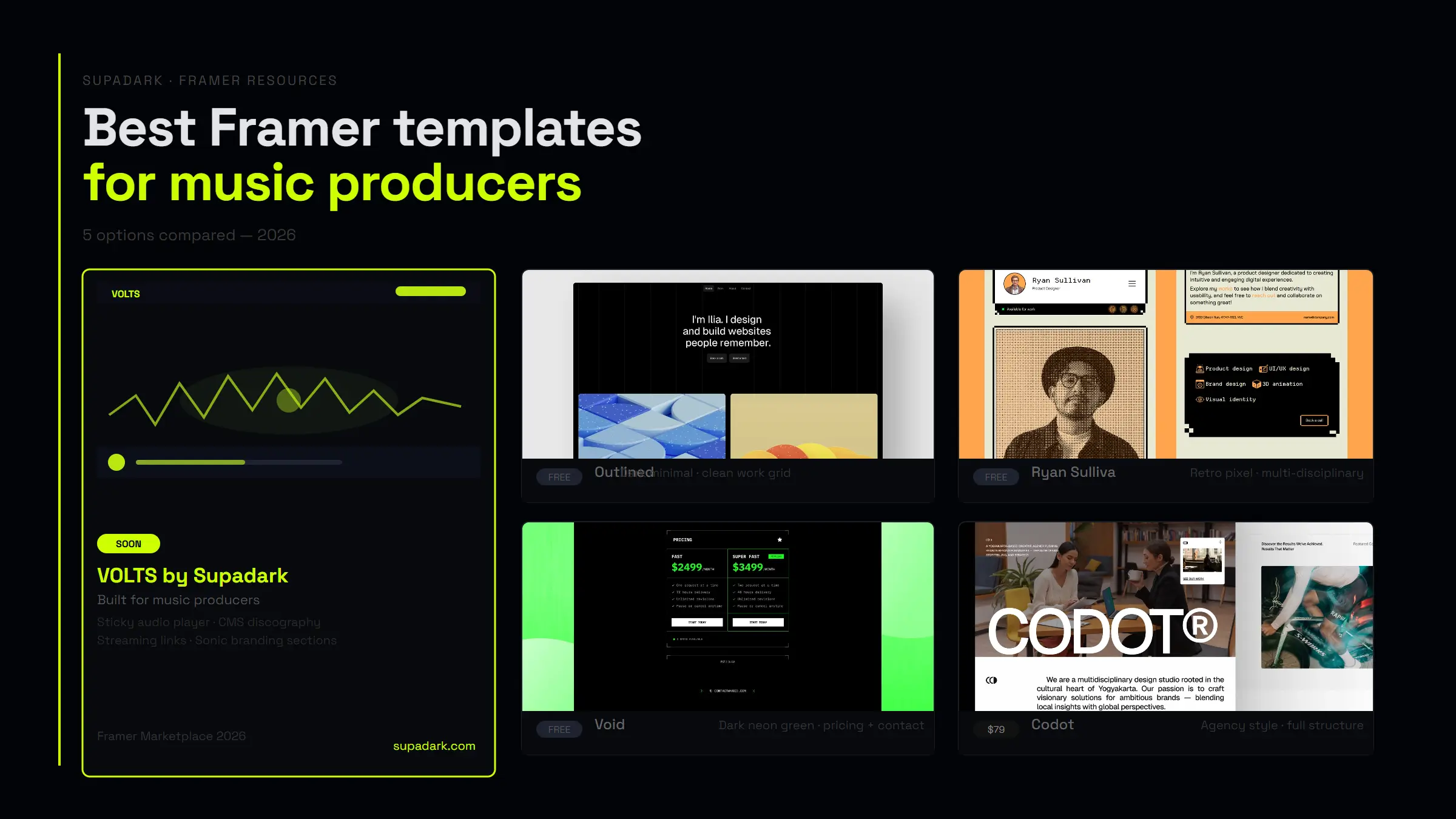
Free templates and components. A free Framer template or a public Figma component does two things at once: it demonstrates craft, and it puts your work in front of people who are actively looking for solutions. Every download is a potential client who has already experienced your quality.
Published process documentation. A detailed breakdown of how you approach a project — the decisions you made, the problems you solved, the tradeoffs you navigated — is a form of free product. It lets potential clients evaluate your thinking before they engage you.
Live demos and interactive prototypes. A working prototype embedded in a case study converts better than a static screenshot. People can interact with it, feel the quality of the motion, test the component behavior. This is the closest a design portfolio gets to a product trial.
Small free deliverables. A quick audit, a 5-minute Loom review of a potential client’s site, a written diagnosis of a specific problem. These create immediate, concrete value and open a conversation that a cold pitch never would.
Activation: getting to the “aha moment” fast
In PLG, activation is the moment a user understands the value of the product. For Figma, it’s the first time you share a file and someone else edits it in real time. For Notion, it’s the first database you build that actually organizes something that was chaotic before.
For a design studio, activation is the moment a potential client thinks: this is exactly what I need.
The fastest path to that moment is specificity. A generic portfolio of “we design beautiful things” activates almost no one. A Framer template specifically built for music producers, or a case study specifically about how sonic branding increased brand recall for a SaaS company — these activate the right people immediately, because the problem matches their problem exactly.
This is why niche positioning is a PLG strategy, not just a marketing preference. The more specific the entry point, the faster the activation.
Retention and expansion through value depth
PLG doesn’t stop at acquisition. The goal is to build a relationship where clients naturally want more, and where the work itself creates that pull.
For designers, retention looks like:
Remix links and editable templates. A client who receives a Framer remix link for their project can keep iterating, referring others, and returning for updates. The deliverable stays alive instead of going into a folder.
Documentation that clients actually use. A design system with a proper README, a component library with usage examples, a brand guidelines doc that someone opens more than once. These extend the value of the original engagement.
Publishing work that generates inbound. When a project is published — as a Framer template, a case study, a note on your blog — it keeps working after the engagement ends. The client may share it. New clients may find it. The work compounds.
The PLG flywheel for a creative studio

When these pieces work together, they create a flywheel:
Free work gets discovered — discovery leads to activation — activated clients engage — engaged clients generate published work — published work gets discovered.
The critical difference from a traditional sales funnel is that the flywheel accelerates on its own. Each piece of published work, each free template, each detailed case study adds to the surface area of discovery. You’re not starting from zero with every new client.
At Supadark, this is why we publish templates on the Framer Marketplace and maintain a content library on sonic branding and web audio design. Each article, each template, each published project is a permanent entry point into the flywheel. A designer searching for how to build an audio component in Framer may not need a sonic branding studio today — but the article builds trust, and trust builds pipeline.
Practical starting points
If you’re a designer or studio looking to apply PLG thinking, the lowest-friction starting point is to ask: what could I publish this week that demonstrates my specific value?
It doesn’t need to be a full case study. A short breakdown of a design decision. A free component with a note explaining why it’s built the way it is. A before/after of a client problem you solved. A specific, honest answer to a question your clients ask in every discovery call.
The constraint is specificity. Generic content serves no one. Specific content — the kind that makes the right person think “this is exactly for me” — is the engine of product-led growth for a creative studio.
TL;DR
Product-led growth for designers means letting your work do the selling. Publish it, make it experienceable, be specific about who it’s for. Free templates, live demos, detailed case studies, and niche content are all forms of “free tier” that create an acquisition flywheel.
The goal isn’t to give everything away. It’s to make the value so obvious, so early, that the conversation starts with a client who already trusts you — instead of one you have to convince from scratch.
Two practical starting points: the best Framer portfolio templates for 2026, and the tool stack we run to ship them without a team.
At Supadark, we build Framer templates and sonic branding systems designed to be published, shared, and used as entry points for client relationships. See the work.